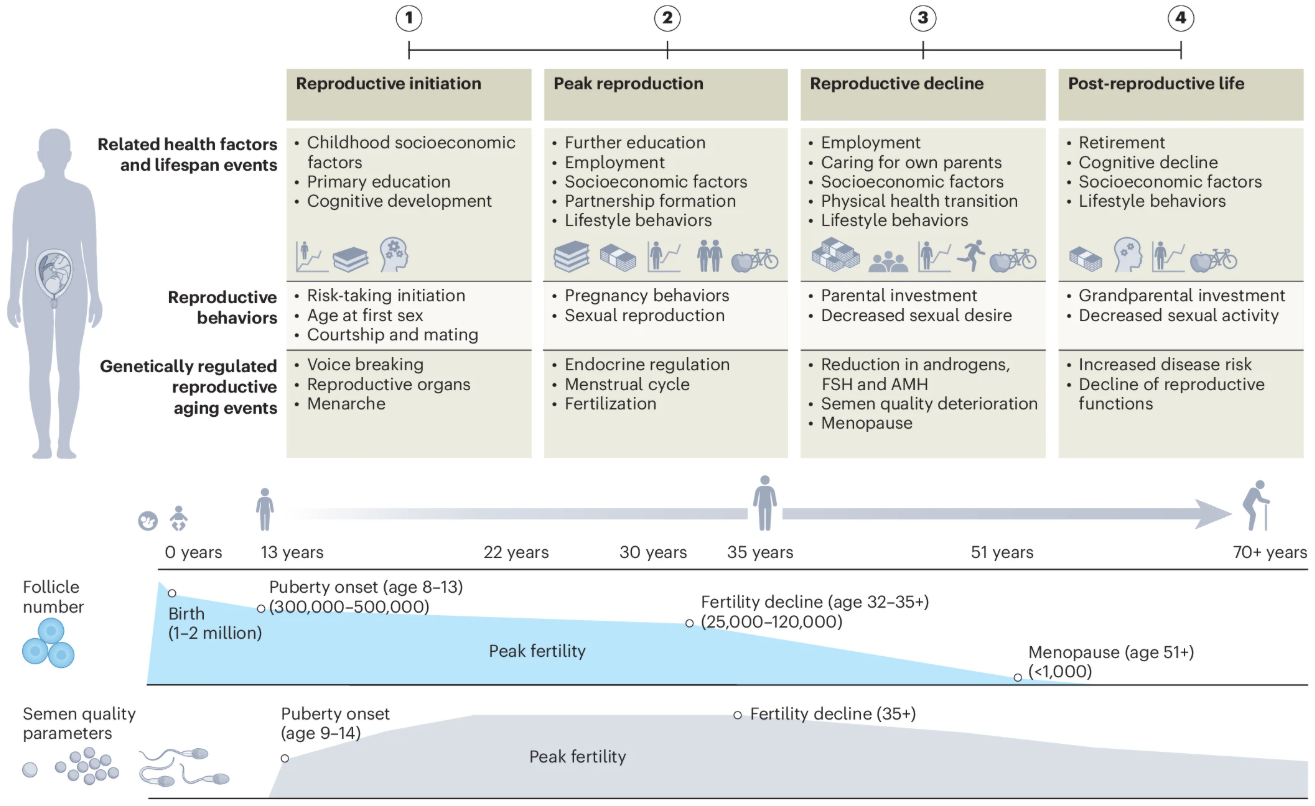
Figure 2 from the article “Genetics of female and male reproductive traits and their relationship with health, longevity and consequences for offspring” published in Nature Aging.
The interplay between male fertility, mental health and sexual function
This article was originally published in Nature Reviews Urology on 27 August 2024.
Abstract
Declining birth rates are drawing attention to male reproductive health, with infertility receiving overdue interest. Alongside genetic and environmental factors, lifestyle behaviours are a key risk factor. Exploring how lifestyle behaviour links to mental health and its interplay with sexual function and fertility can improve understanding of trends in live births and improve men’s health overall.
Cite: Straub, V.J., Mills, M.C. The interplay between male fertility, mental health and sexual function. Nat Rev Urol 22, 1–2 (2025). https://doi.org/10.1038/s41585-024-00936-1
Genetics of female and male reproductive traits and their relationship with health, longevity and consequences for offspring
This article was originally published in Nature Aging on 13 December 2024.
Abstract
Substantial shifts in reproductive behaviors have recently taken place in many high-income countries including earlier age at menarche, advanced age at childbearing, rising childlessness and a lower number of children. As reproduction shifts to later ages, genetic factors may become increasingly important. Although monogenic genetic effects are known, the genetics underlying human reproductive traits are complex, with both causal effects and statistical bias often confounded by socioeconomic factors. Here, we review genome-wide association studies (GWASs) of 44 reproductive traits of both female and male individuals from 2007 to early 2024, examining reproductive behavior, reproductive lifespan and aging, infertility and hormonal concentration. Using the GWAS Catalog as a basis, from 159 relevant studies, we isolate 37 genes that harbor association signals for four or more reproductive traits, more than half of which are linked to rare Mendelian disorders, including ten genes linked to reproductive-related disrders: FSHB, MCM8, DNAH2, WNT4, ESR1, IGSF1, THRB, BRWD1, CYP19A1 and PTPRF. We also review the relationship of reproductive genetics to related health and behavioral traits, aging and longevity and the effect of parental age on offspring outcomes as well as reflecting on limitations, open questions and challenges in this fast-moving field.
Cite: Benonisdottir, S., Straub, V.J., Kong, A. et al. Genetics of female and male reproductive traits and their relationship with health, longevity and consequences for offspring. Nat Aging 4, 1745–1759 (2024). https://doi.org/10.1038/s43587-024-00733-w