Selected publications
- Straub, V. Stop digital platforms treating people as lab rats. Nature 636, 8042 (2024).
- Straub, V. J. & Burton, J. W. Participatory approaches should be used to address the ethics of social media experiments. Commun. Psychol. 3, 28 (2025).
- Straub, V. J. et al. Public attitudes towards social media field experiments. Sci. Rep. 14, 26110 (2024).
Stop digital platforms treating people as lab rats
This article was originally published in Nature as a letter to the editor on 10 December 2024.
In his World View article, Tim Weiss argues that digital platforms increasingly treat users as unwitting participants in experiments, and points out the real-world consequences this has had on gig workers seeking work through job-listing programs (T. Weiss Nature 635, 259; 2024). But the robust ethical framework he calls for to enforce transparency, informed consent and accountability is unlikely to be enough on its own.
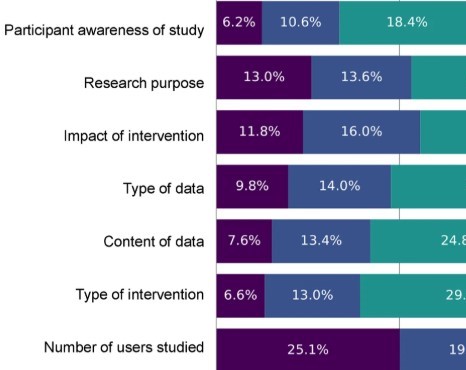
My research shows that the public holds strong, sceptical views on social-media experiments. Nearly 40% of users most value transparency — a higher percentage than for any other factor, including research purpose and the impact of an intervention — and many view practices such as deploying bots or sending private messages as ethically troubling (V. J. Straub et al. Sci. Rep. 14, 26110; 2024). This feedback highlights that attempts to develop ethical standards must involve the public from the start.
Governance in digital research ethics should be participatory, similar to existing proposals for direct user involvement in shaping research practices in artificial intelligence (A. Birhane et al. Proc. 2nd ACM Conf. Equity Access Algorithms Mech. Optim. https://doi.org/grnj99; 2022). Citizen juries, community advisory boards and co-design workshops with users could all provide input on experimental protocols, ensuring ethical decisions and reducing risks. Relying on self-regulation is wishful thinking: public trust demands public input and involvement.
Participatory approaches should be used to address the ethics of social media experiments
This article was originally published in Communications Psychology on 21 February 2025
Abstract
The use of social media field experiments has led to calls for revised ethical guidelines—but none have stuck. A participatory governance approach, similar to developments in AI, can improve practices and collectively align the interests of researchers, platforms and users.
The full article is available here.
Public attitudes towards social media field experiments
This article was originally published in Scientific Reports on 30 October 2024.
Abstract
The growing use of social media field experiments demands a rethink of current research ethics in computational social science and psychological research. Here, we provide an exploratory empirical account of key user concerns and outline a number of critical discussions that need to take place to protect participants and help researchers to make use of the novel opportunities of digital data collection and field studies. Our primary contention is that we need to elicit public perceptions to devise more up-to-date guidelines for review boards whilst also allowing and encouraging researchers to arrive at more ethical individual study design choices themselves. To ground our discussion in real-world examples of online experiments, we focus on recent social media studies in the field of misinformation, polarization, and hate speech research. We conclude by discussing how we can better strike a balance between meeting ethical guidelines and the concerns of social media users alongside maximizing scientific impact and credibility.
The full article is available here.